Locking kick scooters: What site operators should provide
Plan kick scooter locking for schools and shared sites: check stem fit, closure access, padlock operation and anchoring, with clear operating responsibilities.
- ByRollerstop Redaktion
- Published
- 7 min read
Key points
- Check the vehicle pocket and closure together with the kick scooters intended for the site.
- A usable space needs accessible padlock openings and room to operate the closure.
- Resolve anchoring separately from the presence of a lockable closure.
- Decide who supplies padlocks and who helps when a parking space cannot be used.
- A locking provision is neither a theft guarantee nor evidence of insurance cover.
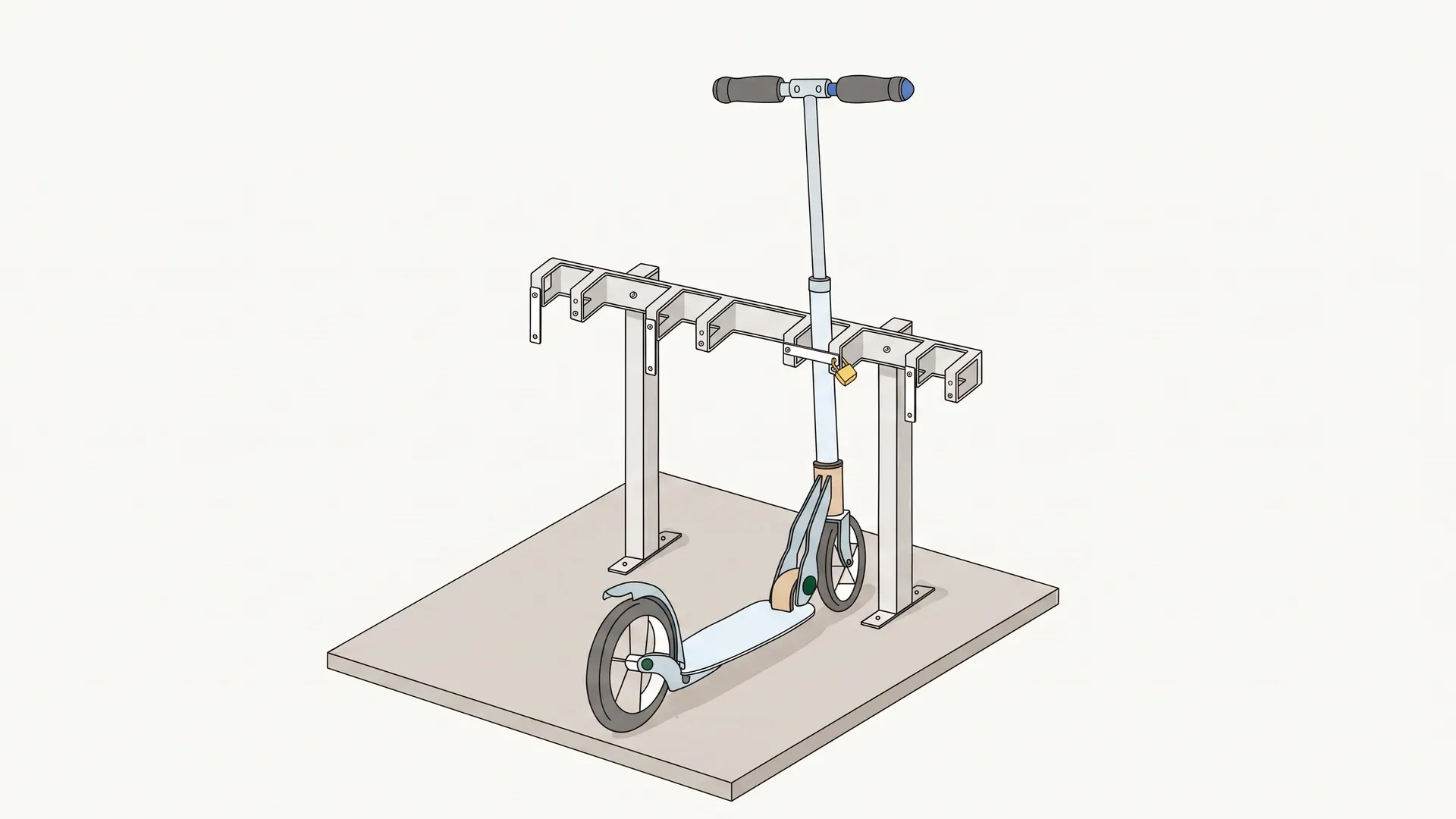
Schematic illustration. Not a dimensional drawing or a real reference installation.
To let users lock a kick scooter at your site, provide a vehicle-compatible pocket, an operable closure, accessible padlock openings and a fixing arrangement assessed for the location. Check these together rather than selecting a stand solely because its catalogue description says “lockable”. A padlock at a parking space does not replace anchoring the installation or checking the scooter against the holder. Schools and other shared-site operators also need a clear approach to supplying locks and handling problems. None of these provisions amounts to a theft guarantee.
What is the difference between parking and securing a scooter?
A parked scooter occupies a designated space. A closed arm is initially just a closed component. The important planning question is how the actual scooter is connected to the stand and whether the intended padlock holds the closure shut. Ask for a demonstration of the complete operation rather than inferring the function from a picture of the product.
The RS series editorial product information describes a rotating closure arm that moves over the steering column and is secured with an ordinary padlock. This is different from passing a bicycle lock through a bicycle frame. Assess the vehicles according to their actual locking arrangement, not an interchangeable “scooter and bicycle” checklist. Use the selected product documents and the intended use as the basis of the assessment.
The scooter information box on page 20 of the Lower Austrian procurement guide recommends lockable stands with users’ own padlocks, good visibility and fixed anchoring. These are planning recommendations published in May 2016, not proof of current statutory requirements at every site. The guide also does not establish that a particular combination of stand and lock will prevent every theft.
Does the stem pocket fit the intended vehicle?
The stem pocket is the part of the stand that receives the scooter’s steering column. Start by checking whether the column can enter the pocket at the required point and whether the selected closure reaches its intended closed position. Include clamps, folding joints or other fittings that may sit near the contact area. Confirm suitability with the supplier using the documents for the exact product configuration.
Where possible, use a scooter that will actually be parked at the site. A broad vehicle category tells you little about the column at the height where it meets the stand. Record the model and useful photographs. If measurements are needed, ask which part should be measured rather than inventing a general limit. Any dimensional acceptance criteria should come from the selected product’s documentation.
The RS 4 kick scooter stand is described on its product page as intended for compact kick scooters and kickboards, with an explicit qualification that it does not fit all e-scooters. Do not extend a successful check with a child’s kick scooter to electric vehicles. Check the deck and adjacent handlebars as well: a column fitting the pocket does not by itself establish that an occupied row is convenient to use.
Can users reach and operate the padlock?
Do not assess only an empty stand. Recreate the intended occupancy and go through the sequence: insert the scooter, move the closure, insert and close the padlock, unlock it and remove the vehicle. Ask the site caretaker to observe where users need to reach and whether a neighbouring scooter obstructs them. This is a practical selection exercise, not a certified strength or security test.
Ask which padlock suits the actual closure. With the intended lock, check that its shackle passes through the openings and that it closes completely. The keyway or combination wheels should remain accessible. Choosing solely by a padlock’s external dimensions is not enough; the relevant issue is how it works with the actual closure and the adjacent vehicle.
The RS series editorial product information lists padlocks as not included. Decide whether users will bring their own or the school will supply them. For personal locks, provide an understandable explanation of the operation checked at the site. For supplied locks, assign responsibility for issuing and returning them and for lost keys. This does not establish insurance cover, which would need to be discussed separately with the insurer.
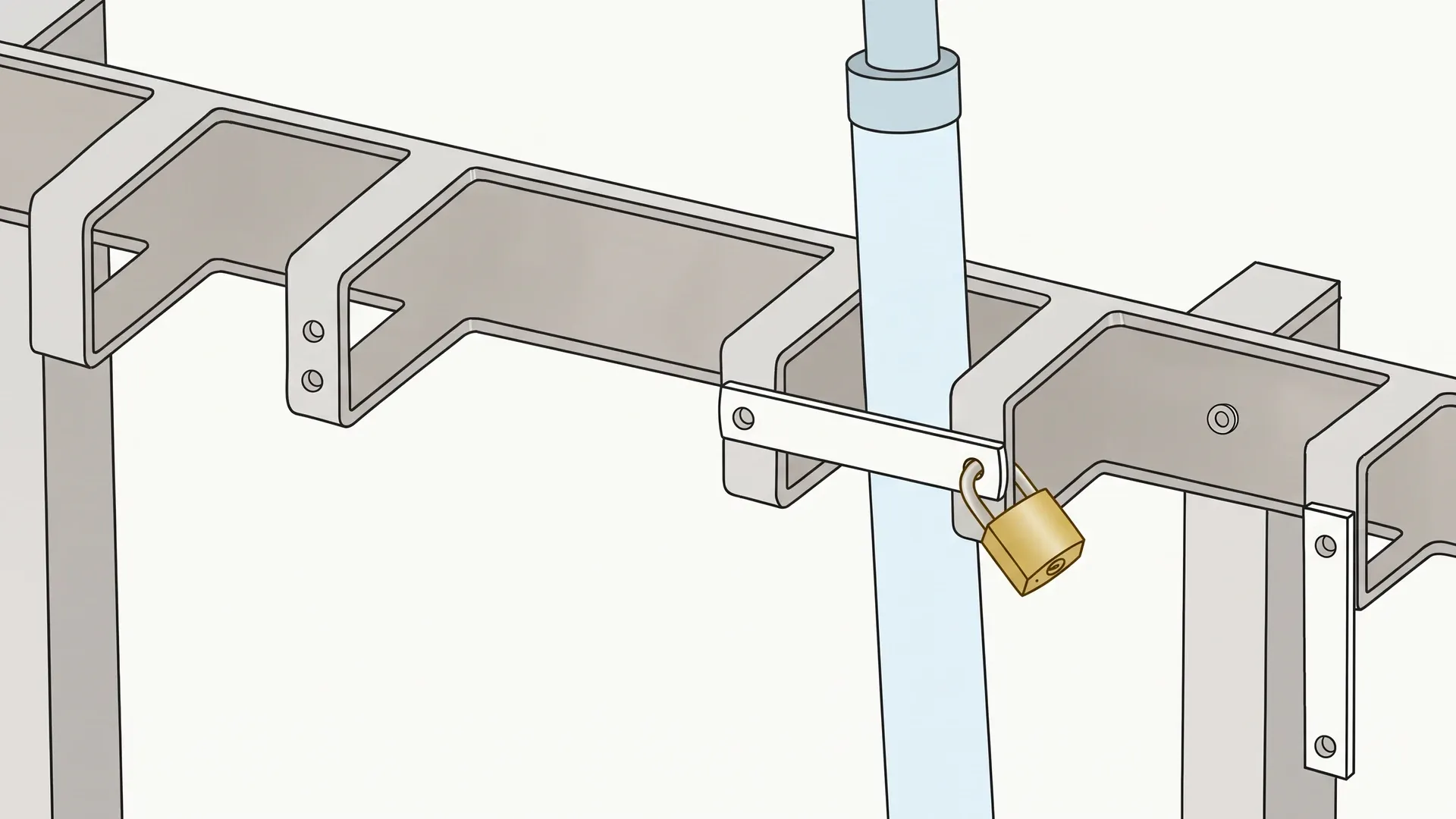
Check the pocket, closure and operating space together
The illustration identifies the area to examine. It does not replace a product data sheet or a practical check with the intended vehicle and padlock.
Schematic illustration. Not a dimensional drawing or a real reference installation.
Why must anchoring be considered separately?
A locked parking space and a fixed installation are different things. The procurement guide’s scooter information box recommends preventing the complete construction from being easily dismantled with the locked scooters and identifies fixed anchoring as the approach. Ask separately about retention at the vehicle and fixing at the site. A stand that can remain upright has not, for that reason alone, been assessed against removal of the entire assembly.
Rollerstop describes different fixing configurations for the RS series. Use the installation instructions for the configuration actually ordered. Record the substrate, its existing construction and the proposed fixing arrangement for the project discussion. The installation and fixing page provides access to the relevant information. Have the fixing selection assessed for the real substrate; this article provides no anchor capacities or foundation dimensions.
Distinguish fasteners for assembling the stand from fixings for the final installation. The RS product information lists screws and anchors for final wall or ground fixing as not included. Record who supplies the appropriate fixings and who installs the stand. This prevents the anchoring from becoming an unresolved task when the equipment arrives.
Where will people stand while unlocking?
An accessible lock also needs usable space in front of it. With the row occupied, check where children or other users stand, where the scooter is withdrawn and whether waiting users narrow a walking route. Do not turn bicycle spacing advice into universal kick scooter dimensions. The relevant factors are the selected stand, the actual vehicles and the site’s circulation arrangement.
The German specialist portal Sichere Schule recommends accessible, visible parking areas and separation between pedestrian routes and parking equipment. Use these points when assessing the location without treating visibility as a universal theft-prevention claim. Sightlines and locking are separate planning issues. Our guide to planning scooter stands at schools covers the broader location and space assessment.
What should the operator document before opening?
Keep a concise record of vehicle examples, the selected stand configuration, the padlock used, installation instructions and photographs of the operation checked. Record unresolved questions as well. Do not turn an unconfirmed vehicle fit into a completed assessment simply because an order needs to be placed.
Identify a contact for jammed closures, lost keys and damaged parking spaces. Decide how problems are reported and how an affected space is handled until the issue is resolved. Use the selected configuration’s documents to inform cleaning and checks, and agree the ongoing responsibilities before opening the area. The procurement guide addresses this early allocation of responsibilities in its installation, service and maintenance section.
For a project-specific discussion, request a quotation with vehicle examples, a site sketch and substrate information. This gives Rollerstop a basis for discussing the proposed stand configuration, locking arrangement and fixing option with you.
Frequently asked questions
How can a kick scooter be locked to a parking stand?
This depends on the scooter and the stand. On the RS series, a closure arm rotates over the steering column and is secured with a padlock. Check the actual combination against the product documents and, where possible, with a vehicle intended for the site.
Is a lockable scooter stand sufficient without anchoring?
The closure and the anchoring serve different purposes. The closure concerns the individual parking space, while fixing concerns the complete stand. The Lower Austrian procurement guide recommends fixed anchoring for scooter installations. Resolve the details using the selected installation instructions and the actual substrate.
Are padlocks included with the RS stand?
The RS editorial product information lists padlocks as not included. Before opening the parking area, decide whether users bring their own or the operator supplies them, and test the padlocks that will actually be used with the closure.
Will every kick scooter or e‑scooter fit the same pocket?
No universal compatibility follows from the vehicle category. The RS 4 product page identifies compact kick scooters and kickboards and limits its suitability for e‑scooters. Check the steering column, fittings, deck and operation against the selected stand configuration.
Sources
- Abstellplätze für Fahrräder, Roller und Co., Sichere Schule, Unfallkasse NRW / Deutsche Gesetzliche Unfallversicherung (DGUV)
- Qualitätskriterien Radabstellanlagen und Fahrradständer (inkl. Scooter), Stand Mai 2016, Nachhaltiges Beschaffungsservice der NÖ Energie- und Umweltagentur / RADLand NÖ
- Rollerständer mit 4 versperrbaren Stellplätzen für Tretroller, Rollerstop