School scooter stands: location, space and safety
Plan scooter stands for schools: assess demand, choose a location, check space requirements, avoid trip hazards and prepare installation and expansion.
- ByRollerstop Redaktion
- Published
- Updated
- 8 min read
Key points
- Assess demand by vehicle type and distinguish observed use from assumptions.
- Locate parking near the entrance but separate it from walking and play areas.
- Check module dimensions, vehicle footprints and access space separately.
- Confirm vehicle suitability, locking arrangements and fixing before ordering.
- Allow space for expansion and assign responsibility for operation.
Schematic illustration. Not a dimensional drawing or a real reference installation.
Plan scooter stands at a school around the routes children use each day. The parking area should be easy to reach and visible, but separate from walking routes and play areas. Establish demand by vehicle type, then check the space needed for parked scooters, access and future expansion. Only then select the system and its fixing method. For school leaders, school owners and municipal education departments, this creates a clear basis for procurement.
How many scooter spaces does your school need?
Start by observing arrivals before lessons. Record the kick scooters, e-scooters and bicycles that arrive, where they are left and which informal parking areas are used. Include vehicles against fences or near the entrance. A fully occupied stand does not reveal total demand if additional scooters are parked elsewhere.
The German specialist portal Sichere Schule recommends surveys or systematic observation of occupancy to establish demand. Use several representative school days and record the conditions. A count on a rainy day provides different context from one taken in dry weather.
Ask whether staff, after-school care or visitors also need parking. If the school is expanding, assess the expected additional demand rather than applying an unsupported percentage allowance. Distinguish measured use from assumptions in your records. You can then use the parking space calculator to explore suitable system configurations.
Where should the parking area be located?
Look for a location near the entrance that is actually used. Proximity is not enough: children should be able to reach the stands without crossing the main flow of pedestrians. Observe where pupils gather before lessons and how they leave the site afterwards.
Sichere Schule recommends placing parking at the edge of the playground or separating it from the playground, with easily accessible approaches that are as free of obstacles as possible. Routes to the stands should be separated from other access routes. Discuss how these planning recommendations apply to your site with the school owner and the responsible designers.
Do not assess the area only when it is empty. Where will children stand while unlocking? In which direction will they pull their scooters out? Could a handlebar extend into a walking route? Include these movements in your site sketch. Keep entrances and existing escape routes out of the proposed parking area; confirm the locally required clear areas with those responsible for the building.
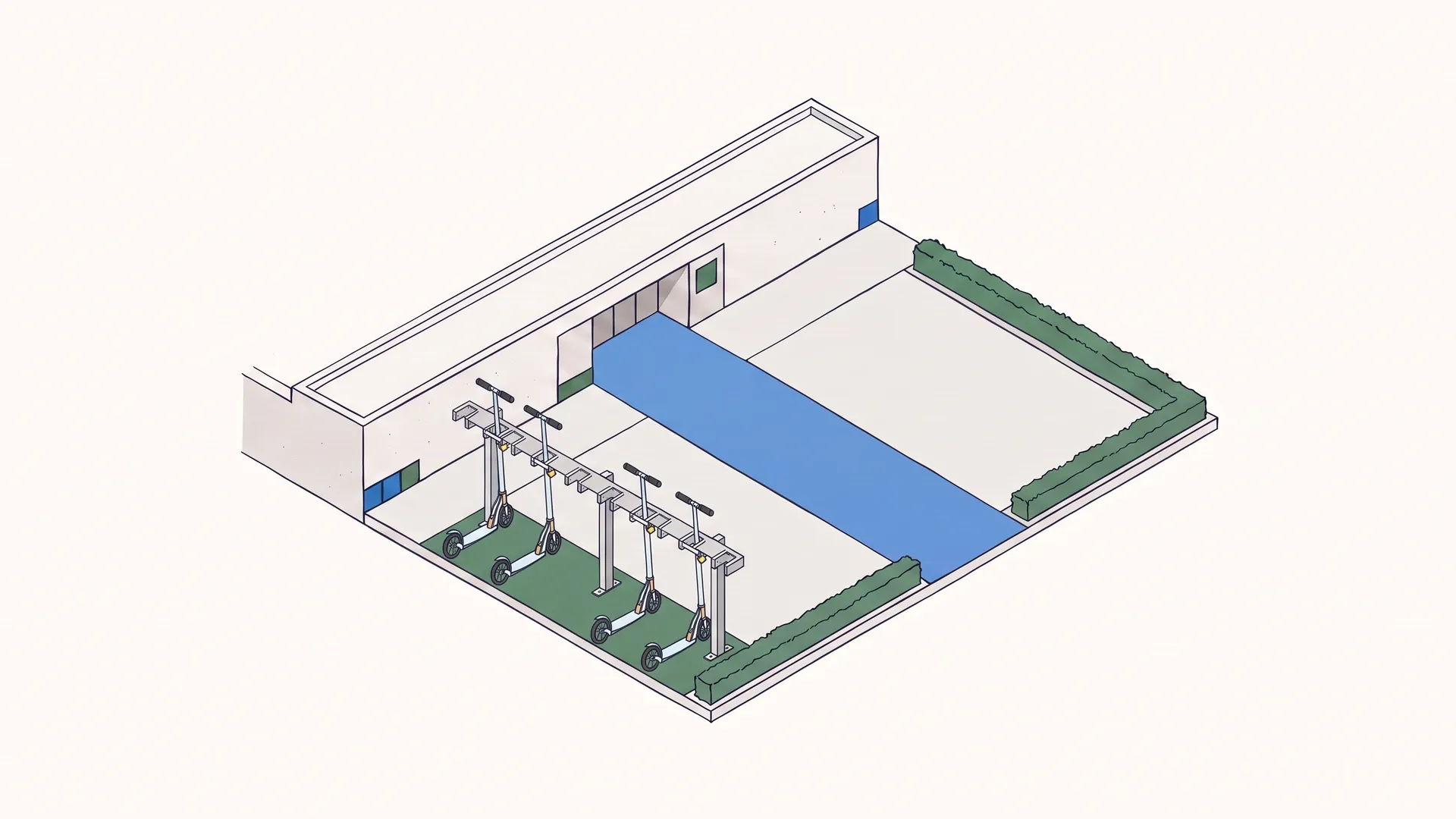
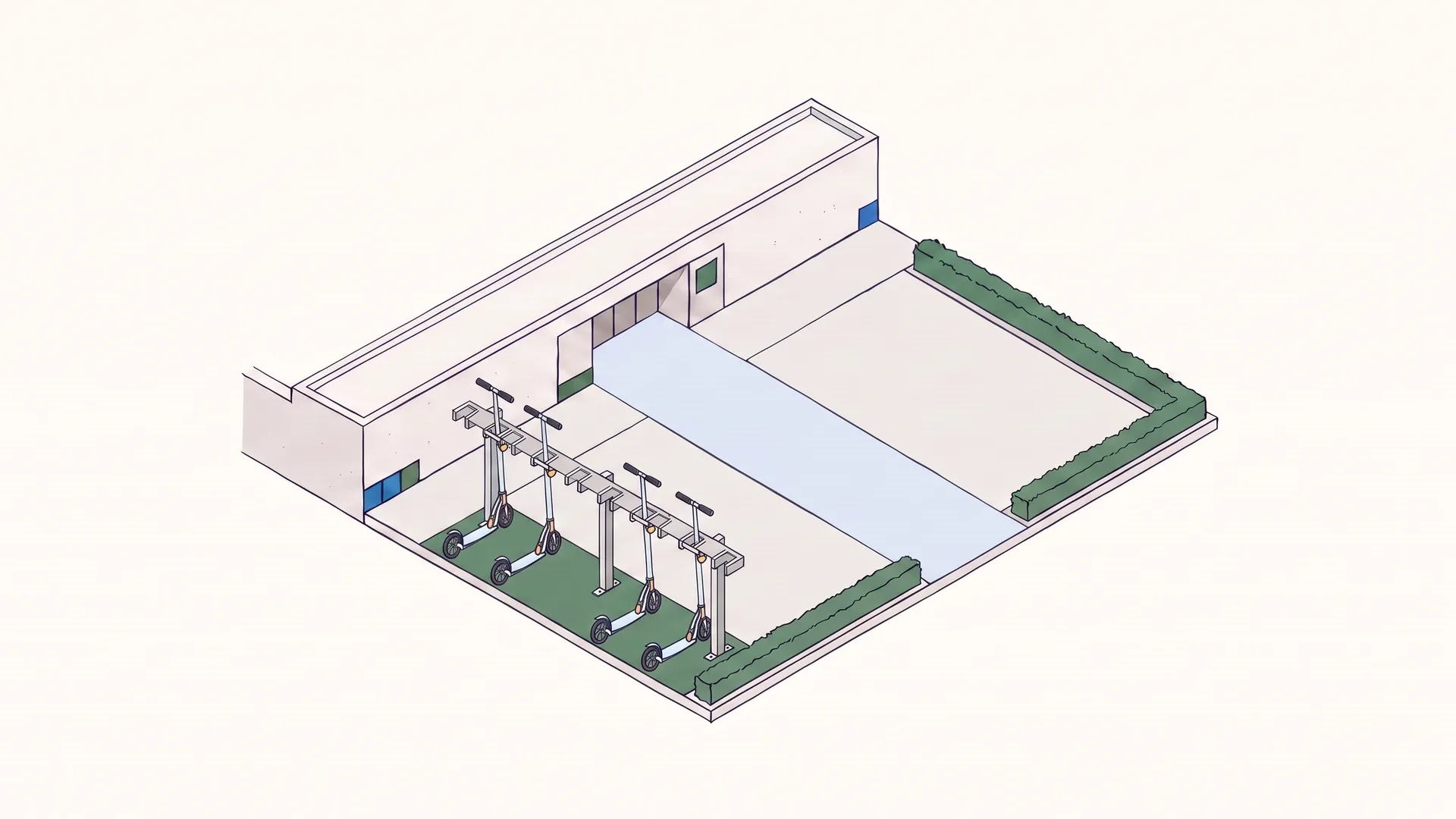
Separate walking and parking areas
Blue: walking route. Green: parking area. The colours explain separate uses, not mandatory ground markings.
Schematic illustration. Not a dimensional drawing or a real reference installation.
How can you avoid trip hazards in daily use?
A clearly identifiable parking area helps distinguish parking from walking space. Sichere Schule explicitly advises that stands should not create trip hazards for passers-by and recommends separating walking routes from parking systems. Consider both the stand itself and the area occupied by parked vehicles.
Walk the proposed routes with facilities staff and school management. Look for projecting decks, scooters positioned across paths and places where waiting children might narrow the route. Agree how the parking zone will be identified and which parking outside it should be discouraged. Markings do not replace a suitable location or enough usable space.
The portal also identifies rounded profiles, the absence of sharp edges and the avoidance of trapping points as selection criteria. Ask the supplier how the chosen design and its operation can be assessed for the children who will use it. A product name alone does not establish suitability for every age group.
How much space should you allow?
Distinguish the length of the module along the row, the area occupied by the vehicles and the space needed to park and remove them. The approach route is part of the plan too. Sichere Schule describes overall demand as a combination of individual parking space, the number of spaces and circulation or manoeuvring areas.
For a specific example, the RS 4 scooter stand has four spaces and a module length of 66 cm according to its product page. This dimension describes the module along the row, not the total area required. Scooter decks project in front of the stand, and users still need space to park and remove their vehicles. Consult the planning documents and check the arrangement on site with the intended vehicles.
Do not transfer bicycle dimensions directly to scooters. The German portal and the Austrian procurement guide cover different systems and planning situations; they do not establish one universal spacing requirement for all scooter stands. Your purchase needs a layout for the selected configuration and a site-specific check of usable routes. Designers can find supporting documents in the architects and planners portal.
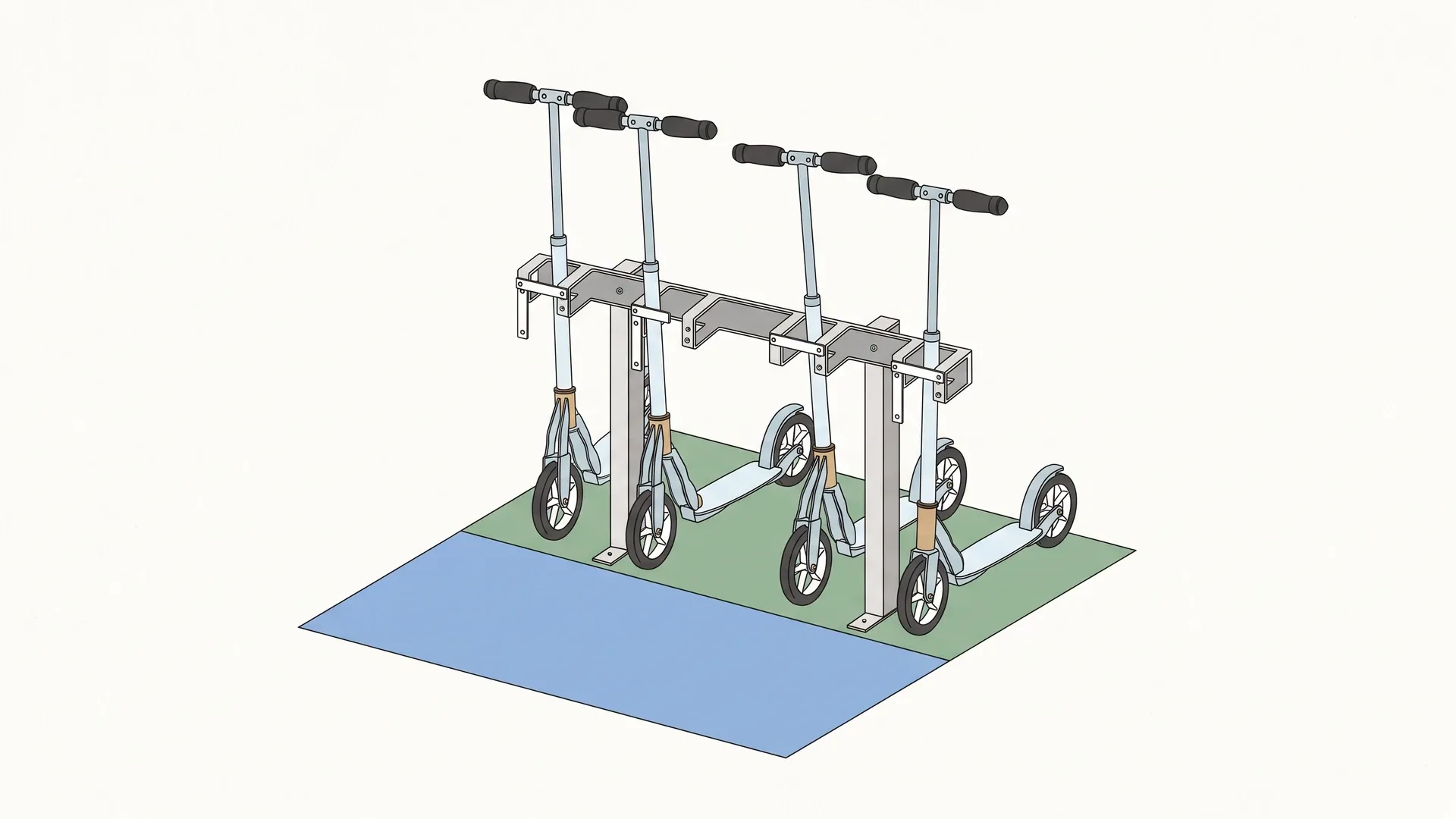
Module dimensions are not the total footprint
Check the stand, vehicle footprint and manoeuvring area separately. The illustration does not specify binding dimensions.
Schematic illustration. Not a dimensional drawing or a real reference installation.
Which system suits the vehicles being used?
Separate the requirements for kick scooters, e-scooters and bicycles. What matters is the documented suitability of the specific design, not whether a supplier calls it a scooter stand or scooter parking system. Check the steering column, deck, arrangement and operation.
The RS 4 product page identifies compact kick scooters and kickboards as its intended uses and notes that it does not fit all e-scooters. If your school needs to accommodate different vehicles, confirm their suitability before ordering. A representative vehicle or its dimensions is more useful than a general label saying the stand is for scooters.
For bicycles, support and locking arrangements need a separate assessment. The Austrian guide recommends being able to lock the frame and a wheel to the stand at the same time. A kick-scooter space does not replace that function. Treat the different vehicle types as parts of a coordinated parking area, not as interchangeable spaces.
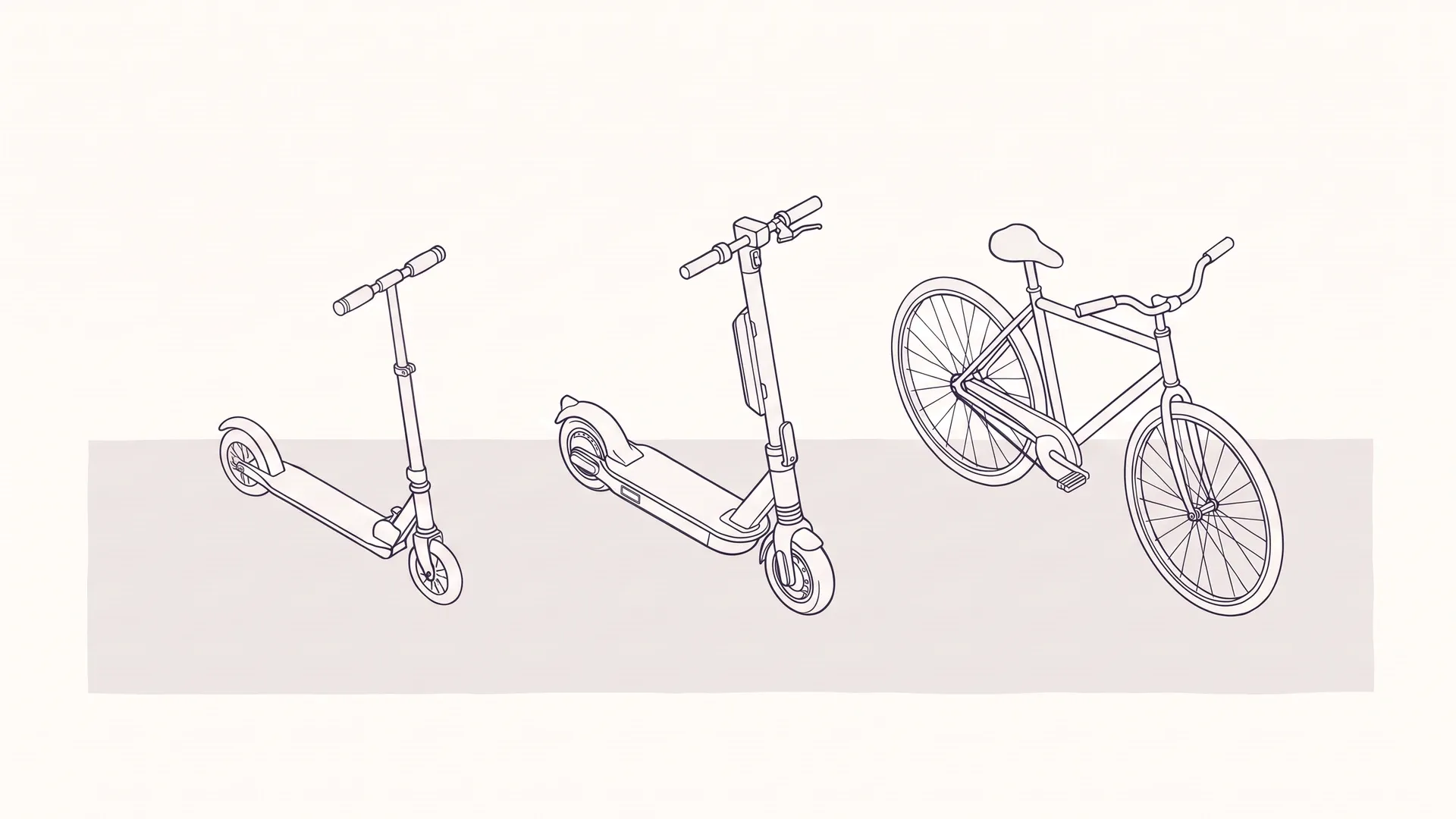
The vehicle type matters
Kick scooters, e-scooters and bicycles require separate planning. Only the three vehicle types are shown, without parking systems or a binding scale.
Schematic illustration. Not a dimensional drawing or a real reference installation.
What should theft protection include?
A visible location, a suitable locking arrangement and secure fixing of the stand serve different purposes. The scooter section of the Austrian procurement guide recommends lockable spaces using an individual padlock, good visibility and fixed anchoring. Visibility does not replace locking, and a lockable space is not a guarantee against theft.
According to the RS 4 product description, its locking bracket rotates over the steering column and can be closed with a standard padlock. Agree with the school and parents who provides the padlock, how children learn to use the system and whom they contact if there is a problem. Check whether the fixing method suits the intended operation as well.
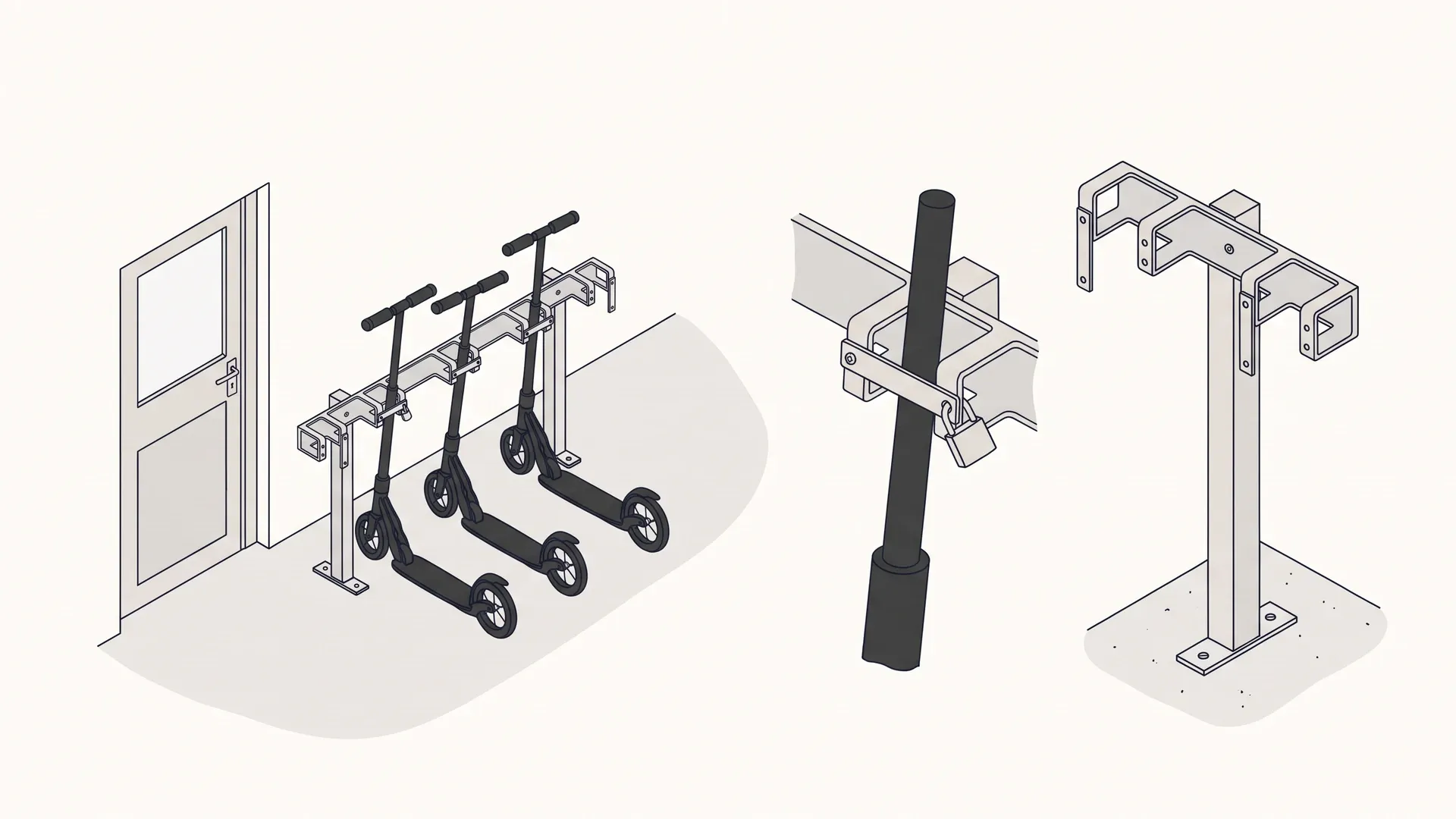
Visibility, locking and fixing
A visible location, a locking arrangement and fixing serve different purposes. No guarantee against theft.
Schematic illustration. Not a dimensional drawing or a real reference installation.
How can the layout accommodate future demand?
Show possible expansion in the site plan from the outset. The Austrian guide recommends allowing physical space for expansion if demand increases. An unused area elsewhere on the playground is not automatically a workable extension of the existing row.
The RS-series editorial product information describes joining multiple modules in a row. For your project, also document the direction in which the row can grow, whether access will remain clear and which fixings will be used. Ask about the required connecting parts and the precise configuration. Modularity is a system characteristic, not a substitute for an expansion plan for your site.
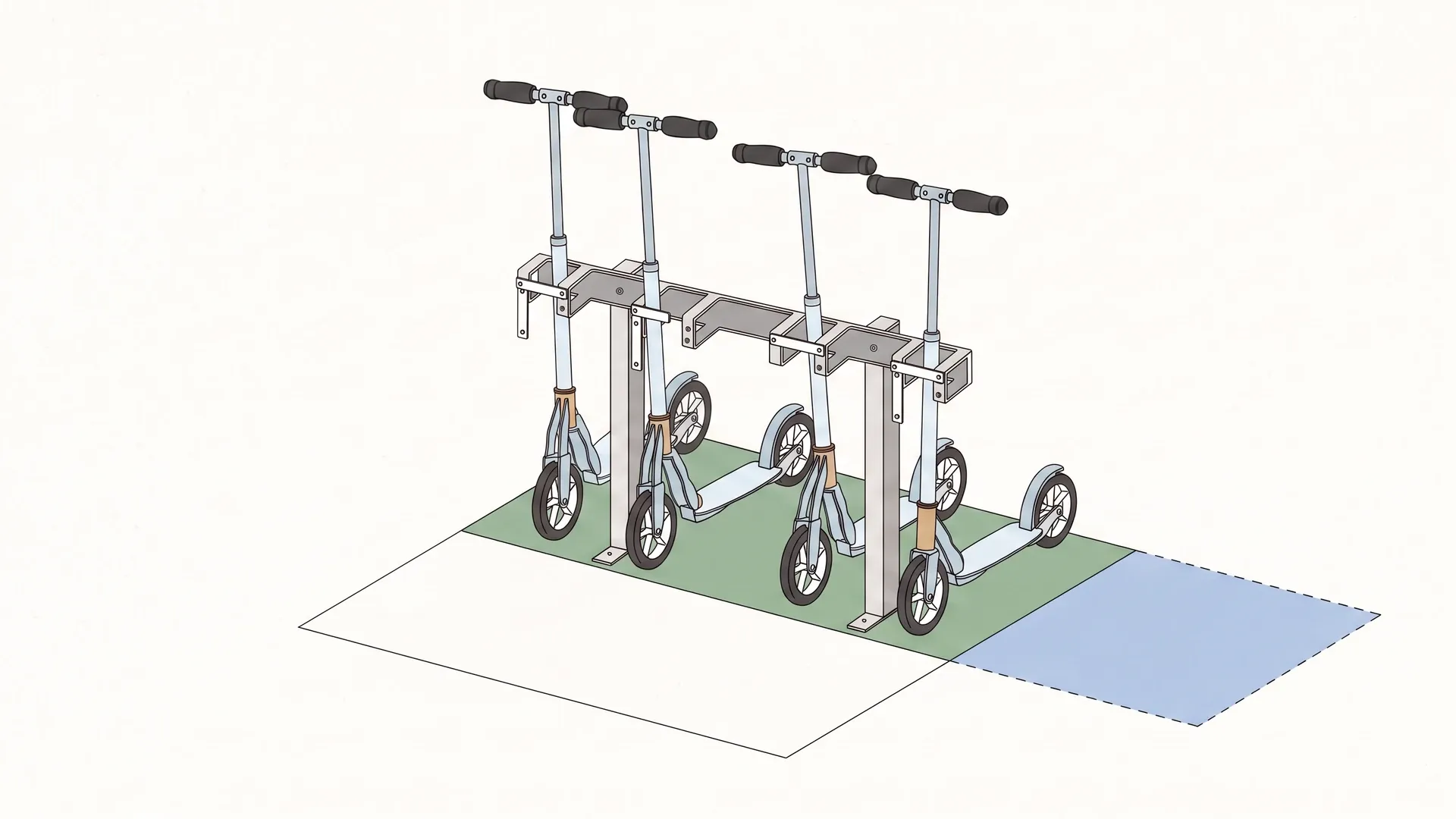
Reserve expansion space early
The dashed area shows a possible extension beside the existing row, not a standardised minimum clearance.
Schematic illustration. Not a dimensional drawing or a real reference installation.
What should be agreed before installation and operation?
Record the existing surface and the proposed fixing method. Rollerstop describes wall brackets and ground posts among the RS-series installation options; use the instructions for the selected configuration. The installation and fixing page provides the relevant information. Distinguish parts supplied for assembling the stand from fixings for final installation.
Assign responsibility for installation, cleaning, functional checks and winter maintenance before ordering. The Austrian procurement guide recommends agreeing ongoing care before construction. Decide how damage will be reported and who deals with blocked or faulty spaces. Include brief operating instructions and an accessible contact person in the operating plan.
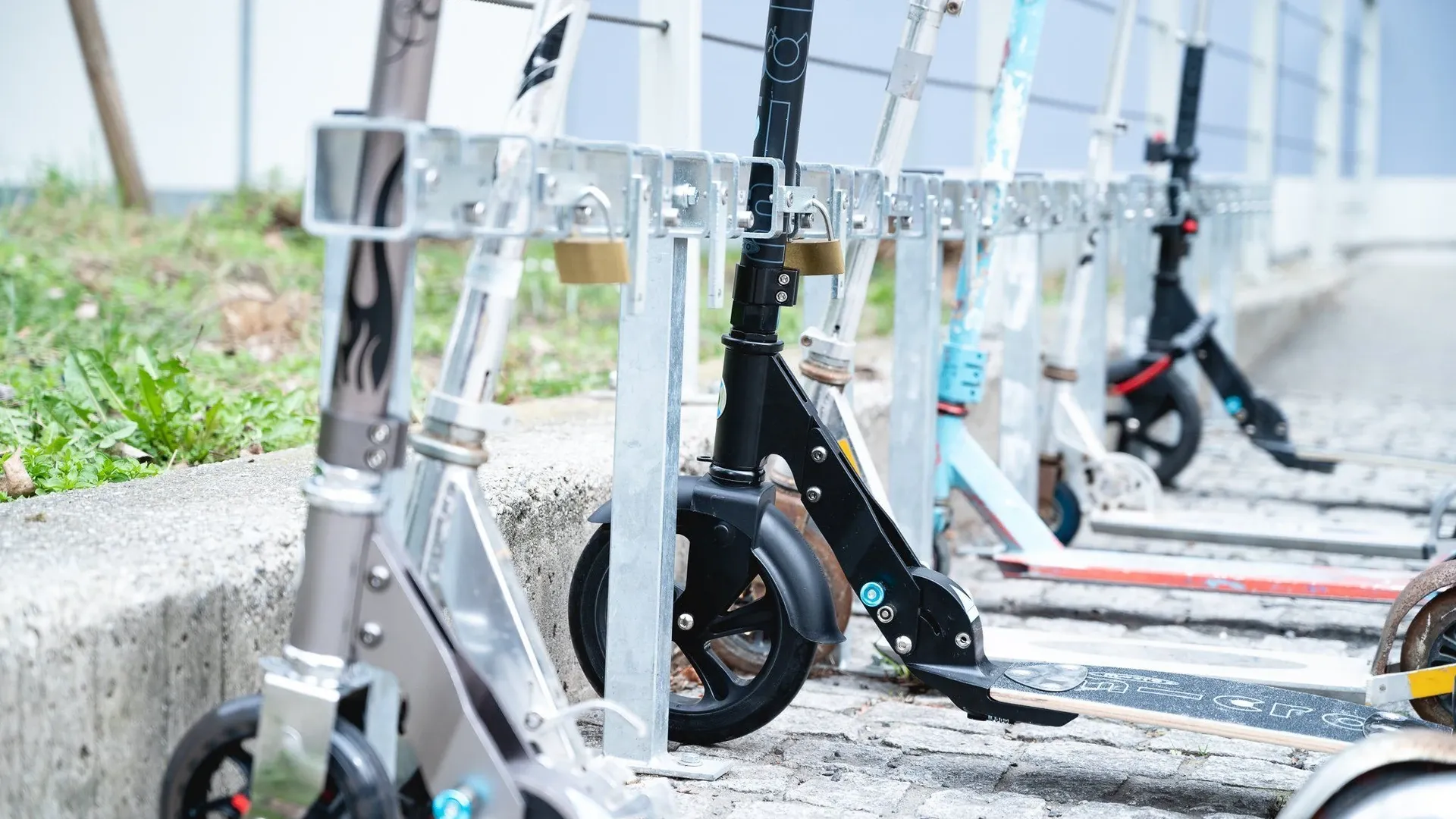
Rollerstop RS stand with parked kick scooters. Use the documents for the selected configuration for the actual installation.
What information supports a useful quotation request?
Bring the findings together in a site sketch and a short demand summary. The following information should be clear to school management, designers and the supplier:
- observed use and expected future demand, separated by vehicle type;
- the chosen location, including approaches, walking routes and the parking area;
- usable space, including room to park and remove vehicles;
- the proposed system, with vehicle suitability and locking arrangements checked;
- the surface, fixing method, direction of expansion and responsibility for operation.
The cited specialist sources provide planning guidance, not blanket approval for your school site. Agree local requirements and the proposed design with the school owner and the relevant specialists.
Use your site sketch, desired capacity and information about vehicles and the surface to request a quotation from Rollerstop. This provides a basis for discussing a parking configuration and fixing method for your school.
Frequently asked questions
How many scooter stands does a school need?
First establish the number of parking spaces needed by vehicle type. Observation and surveys help assess demand. The number of modules then depends on the chosen system; record the assumptions behind any allowance for expansion.
How much space does a scooter stand need?
This depends on the system, vehicles and arrangement. Module length alone is not enough: parked scooters, approach routes and space to park and remove vehicles must also be allowed for. Check the layout for the specific configuration on site.
Can a kick‑scooter stand accommodate e‑scooters?
Not automatically. The RS 4 product page notes that the design does not fit all e‑scooters. Confirm suitability using the intended vehicles and their dimensions.
Does a lockable space prevent every theft?
No. A suitable locking arrangement, the fixing of the system and a visible location should be considered together. A lockable space is not a guarantee against theft.
Sources
- Abstellplätze für Fahrräder, Roller und Co., Sichere Schule, Unfallkasse NRW / Deutsche Gesetzliche Unfallversicherung (DGUV)
- Qualitätskriterien Radabstellanlagen und Fahrradständer (inkl. Scooter), Stand Mai 2016, Nachhaltiges Beschaffungsservice der NÖ Energie- und Umweltagentur / RADLand NÖ
- Rollerständer mit 4 versperrbaren Stellplätzen für Tretroller, Rollerstop