
Kindergarten scooter stands: plan operation and access
Plan kindergarten scooter stands: check small vehicles, test operation with accompanying adults and keep entrance routes clear at drop‑off and collection.
- ByRollerstop editorial team
- Published
- 7 min read

Key points
- Plan drop‑off and collection with accompanying adults as a distinct sequence.
- Check small scooters against the actual holder and closure.
- Vehicle overhangs and operating space must not take over the access route.
- Clarify fixings, padlocks and ongoing care before ordering.
When planning scooter stands for a kindergarten, do not simply scale down a school playground layout. Start by checking who will park and lock each scooter, which small kick scooters actually arrive, and how accompanying adults will then reach the entrance. A suitable installation is easy to reach beside the path, provides room to use the stand and keeps access clear during drop-off and collection. Whether children can manage individual steps themselves needs to be assessed with the actual scooters and your teaching team, not from a product illustration alone.
Schematic illustration. Not a dimensional drawing or an actual reference installation.
How does this differ from planning for a school playground?
At a kindergarten, consider the handover between a child and the accompanying adult as a planning issue in its own right. Decide whether adults will place scooters in the stand and lock them, or whether children will be supported in doing so. Build that decision into your layout: the space needed is not just the scooter’s footprint, but also somewhere for a person to stand, bend down and handle a lock.
Look at arrival as a complete sequence. A family may have a pushchair, bags or another child with them. Check on site where they can pause, where the scooter will remain and how they will continue towards the gate. This is an editorial planning recommendation, not a general statement about every kindergarten. The guide to planning school scooter stands covers the basics of choosing a location; this article focuses on drop-off and collection with an accompanying adult.
Distinguish privately owned scooters used for the journey from the kindergarten’s own toys and ride-on vehicles. Unfallkasse NRW’s Sichere Kita portal recommends orderly storage for toys and vehicles, giving a suitably positioned equipment shed as an example. That does not establish a general requirement to install a particular scooter stand. Instead, agree separately where private kick scooters will park during the day and how staff will put away the kindergarten’s own vehicles after use.
Walk through the entrance area with accompanying adults
Do not draw access merely as a line between the site boundary and the door. Mark the door swing, the gate area, existing fixtures and the point where scooters will be guided towards the stand from the direction of arrival. Then leave a route alongside this for an accompanying adult to continue to the entrance. This allows you to assess whether parking a scooter would create an additional bottleneck.
A clearly visible position near the entrance is a sensible starting point. The Lower Austrian (NÖ) guide to bicycle parking facilities, including scooters, identifies good visibility, proximity to the entrance, easy access and an understandable operating principle in its scooter information section. It provides specialist guidance dated May 2016, not evidence of the local building regulations currently in force. We explicitly do not adopt its bicycle spacing figures as minimum dimensions for children’s scooters.
Test possible locations with a row of parked scooters rather than an empty stand alone. Include handlebars, decks and wheels when assessing the occupied space. Also check whether someone can remove a scooter while another person unlocks the neighbouring space. If this blocks the route through, a different location or arrangement will be more useful than adding further spaces within the same bottleneck.
Check small scooters against the actual holder
A description such as “for kick scooters” does not prove that every children’s vehicle at your site will fit. Make a short vehicle list and bring typical models for a practical fit check. Record where the stem is intended to be held, whether covers or a folding mechanism get in the way, and whether the scooter can be placed in the holder without unwanted contact. Check unusual designs separately rather than inferring suitability from a similar product description.
According to Rollerstop’s product documentation, the RS series is intended for classic kick scooters and kickboards. On the RS 4, a rotating closure arm moves over the scooter’s stem and is locked with a standard padlock. The product page lists kindergartens among its applications. However, that replaces neither a fit check with a particular small scooter nor an assessment of who can operate the closure.
Do not silently treat balance bikes, children’s bicycles and pushchairs as the same vehicle category. Even if a particular wheel fits into an individual holder, this does not demonstrate suitable support, operation and locking for every model. For different geometries, ask for advice with photographs and vehicle details. A documented fit check is more useful for your decision than an apparently universal holder.
Try out parking and locking in practice
Have the intended procedure demonstrated on a sample and let the people who will use it try it out. Observe placing the scooter in the holder, moving the closure arm, reaching the lock and removing the scooter. Check whether the person carrying out these steps can comfortably reach the operating point without squeezing between neighbouring vehicles. Record where assistance is intended.
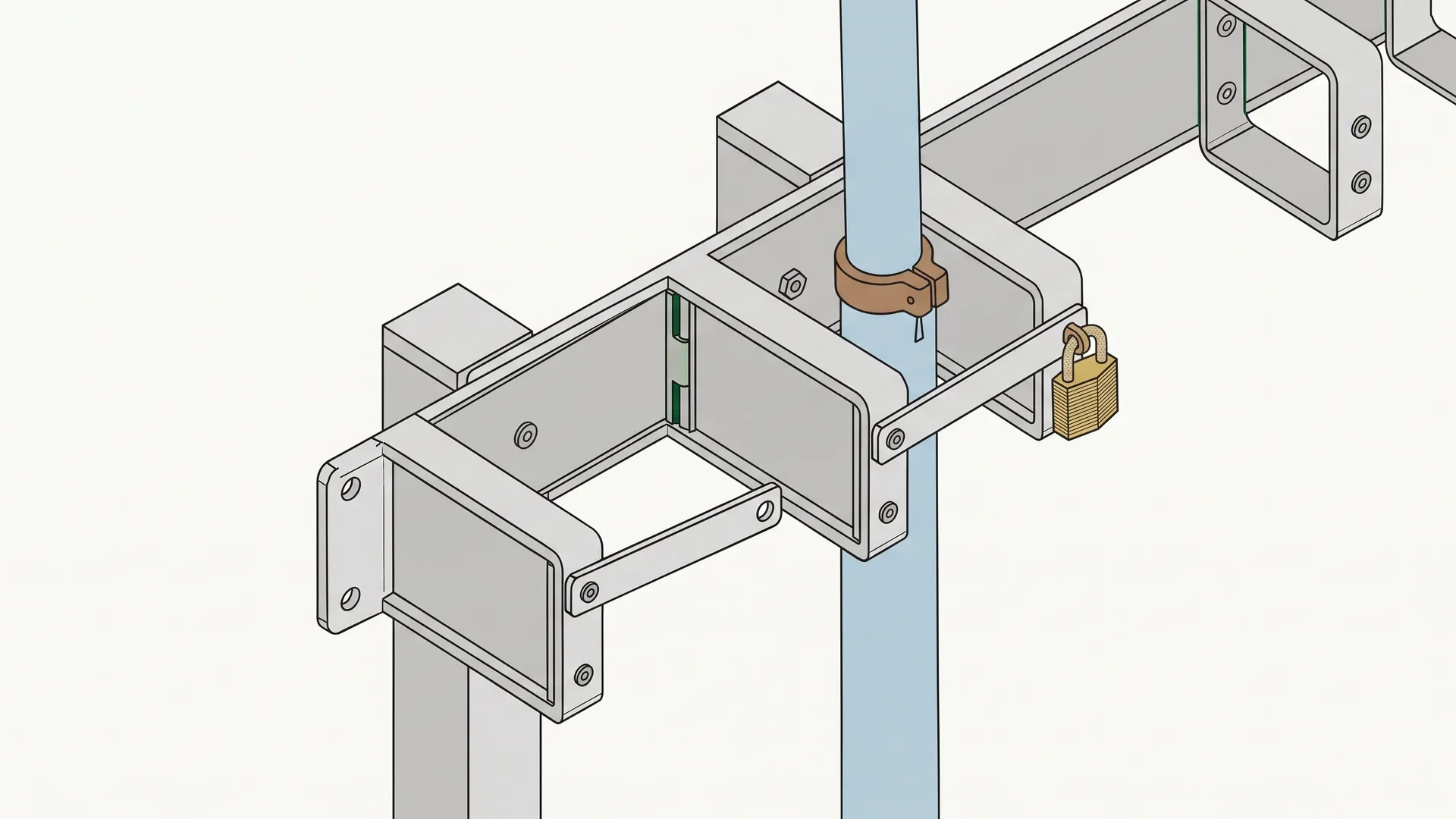
Schematic illustration. Not a dimensional drawing or an actual reference installation.
The drawing illustrates the principle of the holder and its closure. It does not establish a suitable installation height or show that a child can use it independently. Do not change the fixing arrangement or installation height on the basis of a schematic illustration alone. Check the chosen installation against the relevant documentation and your site’s requirements.
The operating procedure also needs to cover locks. Agree whether families will bring their own padlock, who will help if difficulties arise and how a forgotten key will be handled. The RS documentation does not list a padlock as part of the supplied equipment. The ability to lock a scooter is not a guarantee against theft; avoid making such promises in information for parents.
Plan space, fixings and room for expansion together
Assess demand at actual drop-off and collection times, distinguishing scooters left for the day from those taken away again. Use the parking space calculator to prepare a possible row configuration. A calculated module length does not replace a site plan showing vehicle overhangs, space for operating the stand and the access route that will remain.
Check fixings against the chosen version and the existing surface or supporting structure. The RS product documentation distinguishes the screws supplied for assembling the stand itself from the screws and wall plugs or anchors for final installation, which are not included. Have the appropriate on-site fixing method established before treating the order as complete. The installation information helps identify the documents you need.
The RS series can be extended with additional modules. Even so, reserve genuinely usable adjoining space for future expansion, rather than part of the required walkway. Document existing obstacles and the intended direction of expansion. An additional section is only useful if scooters and accompanying adults will still have enough room there.
Hand over a clear operating procedure
Give your team a short usage agreement as well as the installation itself. It should identify the area for private kick scooters, the assistance intended for locking them and the person or team responsible for receiving feedback. Add who will report concerns about fixings, closures or the surface, and how cleaning and keeping access clear will be organised.
The NÖ guide recommends clarifying responsibility for ongoing upkeep before installation. A fixed inspection interval or a local legal obligation cannot be inferred from it as a blanket rule for your kindergarten. Agree specific procedures with the kindergarten operator, the responsible planning professionals and the manufacturer’s documentation. After the stand comes into use, reassess whether drop-off and collection work as intended.
To prepare your project, start with a site plan, photographs of the entrance, the vehicle types you have observed and a description of the intended procedure. Use Request a quote to submit this information and ask for a project-specific selection of suitable equipment and planning documents.
Frequently asked questions
Can every child use a scooter stand independently?
This cannot be promised as a general rule. Assess the intended actions with the actual scooters and your teaching team. Define the assistance that adults will provide.
Will every small vehicle fit an RS stand?
No, a description for kick scooters does not establish universal compatibility. The RS series is intended for classic kick scooters and kickboards. Check the actual geometry and assess balance bikes and pushchairs separately.
What spacing applies at a kindergarten?
This article does not prescribe universal minimum distances. Check vehicle overhangs, operating space and access on the site plan, and clarify local requirements for the project. Bicycle dimensions in older guides are not general dimensions for children’s scooters.
Is a padlock supplied with the RS 4?
The RS documentation does not include a padlock in the supplied equipment. Agree with families how locking will be organised. The ability to lock a scooter is not a guarantee against theft.
Sources
- Qualitätskriterien Radabstellanlagen und Fahrradständer (inkl. Scooter), Stand Mai 2016, Nachhaltiges Beschaffungsservice NÖ / RADLand NÖ
- Aufbewahrung – Sichere Kita, Unfallkasse NRW
- RS 4 – Rollerständer für Tretroller: Produktdetails und Lieferumfang, Rollerstop
Matching products

Read more
 Planning & space requirements
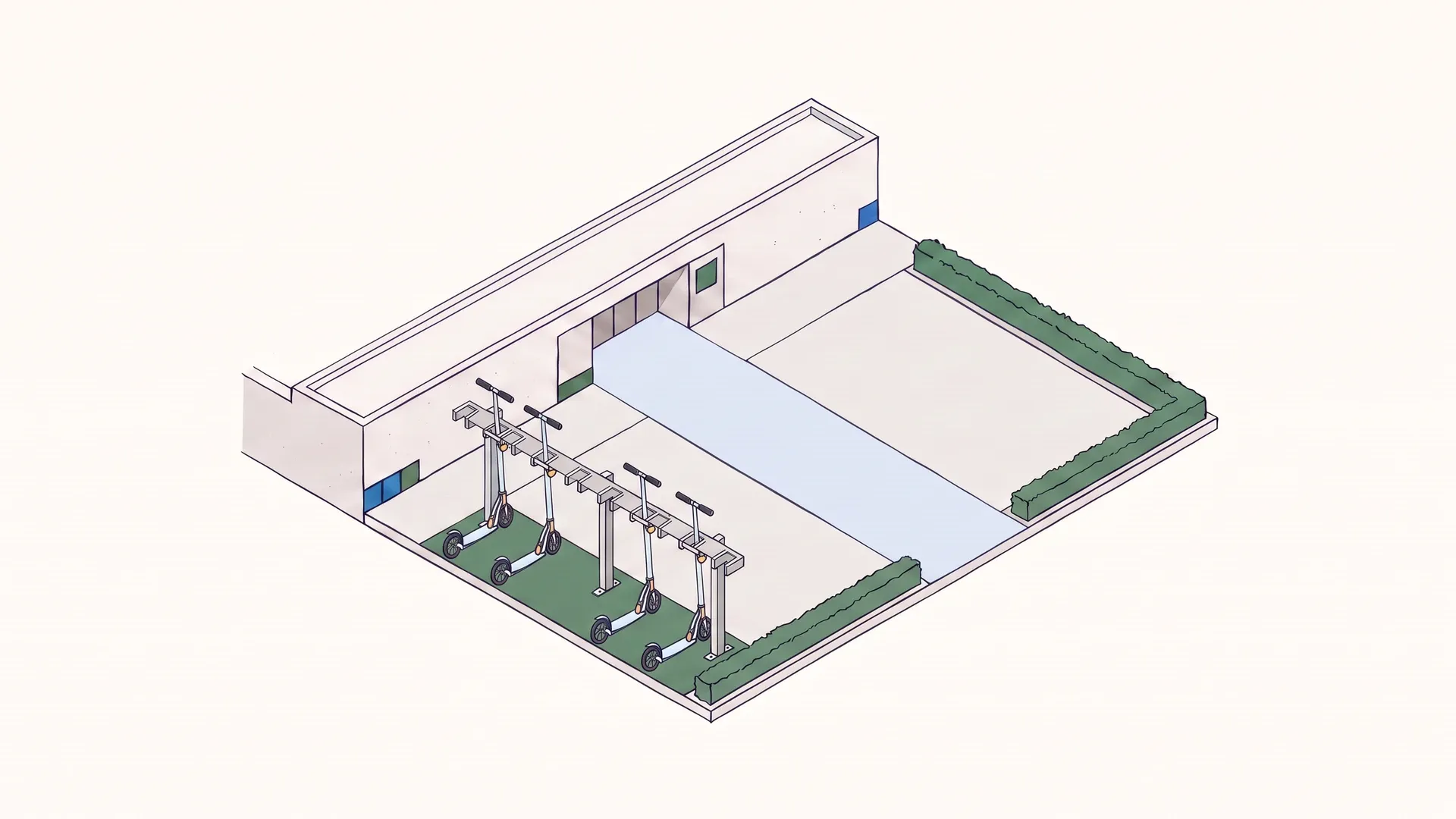
School scooter stands: location, space and safety
Plan scooter stands for schools: assess demand, choose a location, check space requirements, avoid trip hazards and prepare installation and expansion.
8 min read
 Order & security
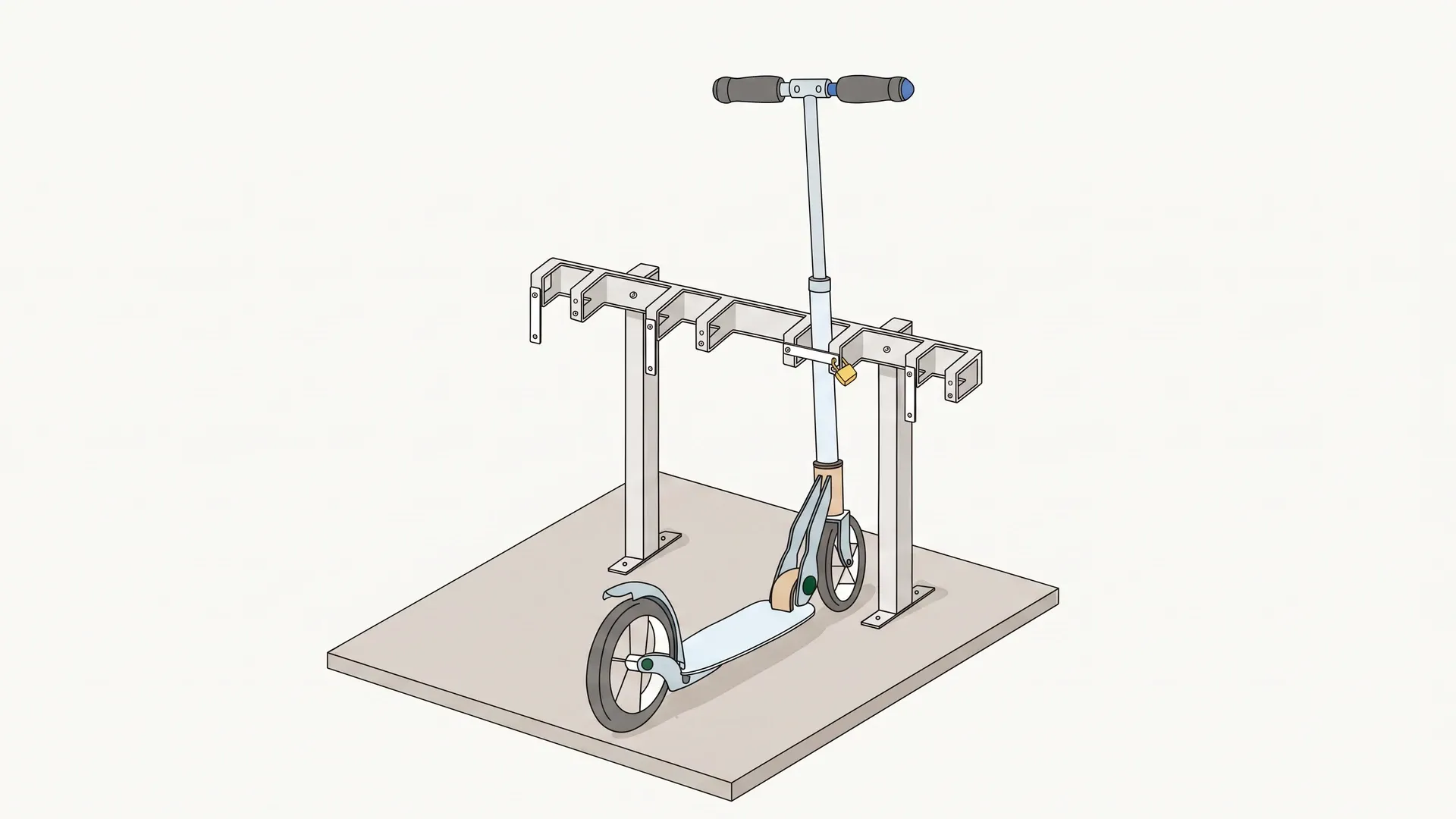
Locking kick scooters: What site operators should provide
Plan kick scooter locking for schools and shared sites: check stem fit, closure access, padlock operation and anchoring, with clear operating duties.
7 min read