
Choosing parking equipment: support, locking and quality
Compare parking equipment using evidence: assess vehicle support, lock operation, materials, installation and ongoing care for purchasing and public buyers.
- ByRollerstop editorial team
- Published
- 6 min read

Key points
- Compare the same requirements for every offered version.
- Assess vehicle support and lock operation as separate functions.
- Material descriptions and test marks need identifiable documentation.
- Include fixing, scope of supply and ongoing care in the decision.
Do not choose parking equipment solely by its shape, nominal capacity or material description. For purchasing teams and public-sector buyers, the important question is whether the offered version supports the actual vehicles, allows the intended locking operation and comes with identifiable product, installation and operating documents. Compare every offer against the same requirements and explicitly record missing evidence as unresolved.
This article provides technical selection guidance, not procurement-law advice or an independent product test. The guidance published by Nachhaltiges Beschaffungsservice NÖ and RADLand NÖ, dated May 2016, provides a useful structure: theft prevention, ease of use, accessibility, materials, installation and maintenance are separate assessment areas. Its older dimensions and legal references are not adopted here as current universal requirements.
Schematic illustration. Not a dimensional drawing or an actual reference installation.
What must the offered version actually do?
Start with a brief account of the intended use: who parks which vehicles, how they reach the area and who will look after it. A school with conventional kick scooters raises different questions about holders from a bicycle area at an office building. Sharing a location does not make the systems interchangeable.
Create the same assessment fields for each offer: vehicle suitability, support, lock operation, material evidence, fixing and ongoing care. Add the exact offered version, the corresponding document and any outstanding question. This makes it easier to distinguish evidence for the proposed model from general statements about an entire product family.
An editorial comparison record could use labels such as “documented”, “check on a sample” and “document missing”. These labels are neither certification nor a prescribed scoring method. Define the decision criteria for the project and record which unresolved questions must be answered before ordering. A comprehensive brochure does not replace this model-by-model identification.
Assess support and locking separately
Holding a vehicle and securing it with a lock are different functions. First establish where the equipment guides or supports the vehicle and whether it can be parked and removed in the intended manner. Then examine the actual point at which a lock can be operated. A clearly visible holder does not by itself demonstrate a suitable locking arrangement.
For bicycles, the Lower Austrian guide identifies locking the frame and wheel simultaneously, together with support against rolling and tipping, as quality criteria. Do not simply transfer bicycle geometry to kick scooters. A scooter needs a stem pocket and closure suited to the actual vehicle. The guide also discusses scooters in a separate information box.
For the RS 4 for conventional kick scooters and kickboards, Rollerstop describes a rotating closure arm over the steering stem, secured with a conventional padlock. The product documents do not classify the RS series as a regular bicycle stand. Use this functional description for a specific comparison, not as proof that every possible vehicle will fit or as a guarantee against theft.
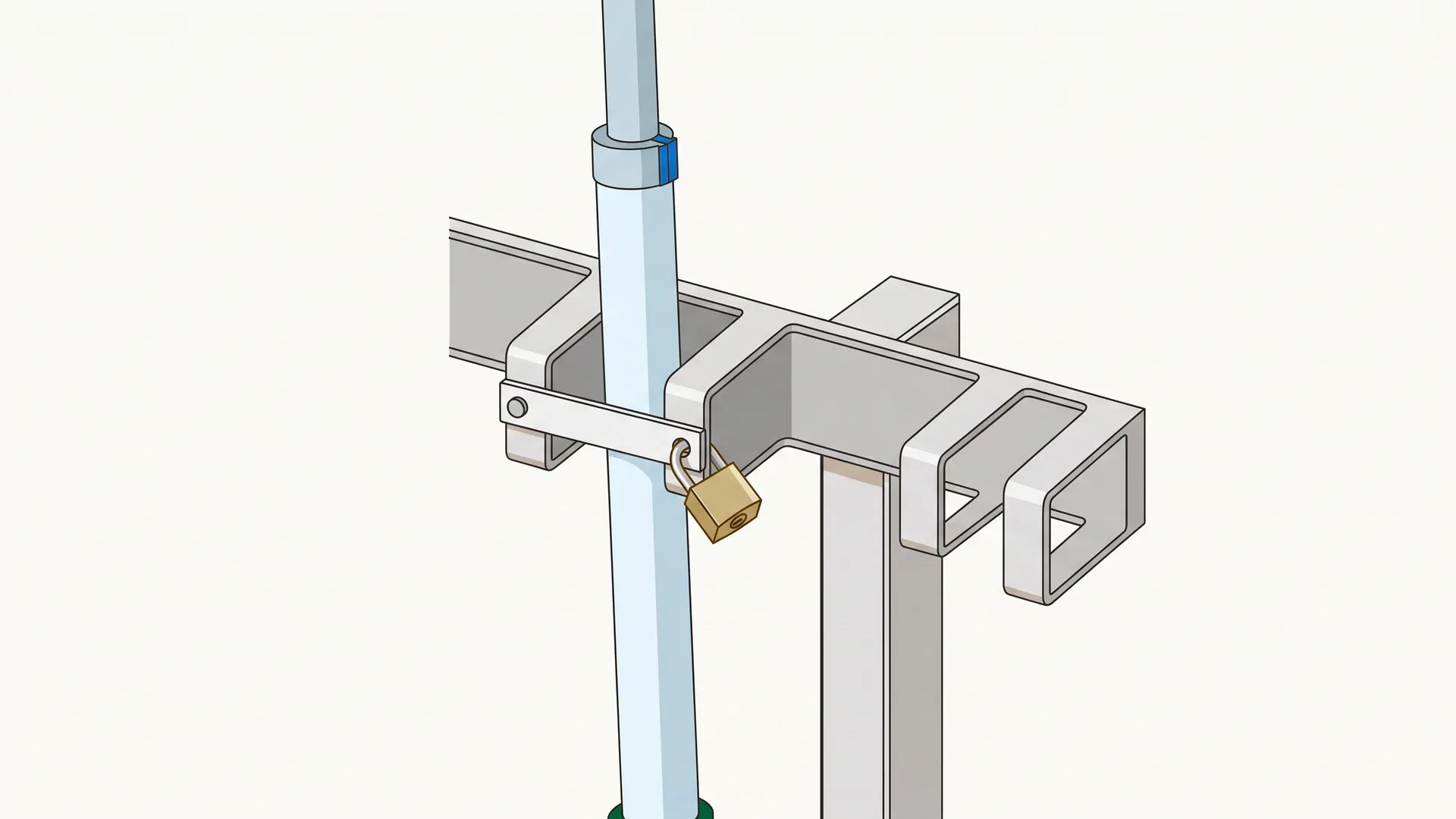
Schematic illustration. Not a dimensional drawing or an actual reference installation.
The detail identifies the contact and operating area to examine. It does not replace a technical drawing or a practical check using the intended vehicle and lock. Showing a padlock is not evidence of a tested resistance rating either.
How can a sample demonstration be useful?
If the documents do not adequately explain the operation, arrange a practical comparison using representative vehicles. Record the sample model and version, together with the vehicles and locks actually used. Without those details, it may later be unclear which configuration the observations concerned.
Follow the complete sequence: approach with the vehicle, position it, release it where intended use allows this, operate the lock, unlock it and remove the vehicle. Observe access to the closure and the neighbouring spaces. Check whether bags, handlebars or other attachments interfere with operation. These are suggested observations, not a standardised test procedure.
Write down the specific result rather than simply ticking “safe”. “Accessible with the demonstrated vehicle” is different from “suitable for all vehicles”. Identify vehicle groups that have not been checked. Similarly, an observation of normal operation is not a load, vandalism or theft-resistance test. Informal trials do not replace specialist testing where that is required.
Match material and quality evidence to the offer
A material name alone does not explain the version being supplied. Request a data sheet that clearly identifies the components, surface treatment and proposed configuration. Check whether a stated surface treatment applies only to the main body or also to other parts. Leave missing information as an explicit question in the comparison rather than assuming equivalence.
Rollerstop describes the RS 4 as made from hot-dip galvanised steel. This article does not infer a universal service life from that statement, nor that a complete installation, including fixings, moving parts and access, requires no inspection. Material description, product function and operator responsibilities are separate matters. Request the associated care and operating information as part of the comparison.
If an offer cites a test mark or certificate, obtain the underlying document. Compare its product identification, covered version, scope of assessment and any stated period with the offer. A historical document, without checking that correspondence, is not proof of current comprehensive certification. This article awards no quality mark and makes no claim that a particular model currently holds certification.
Include fixing and ongoing care in the comparison
A suitable holder does not automatically settle installation. The Lower Austrian guide treats firm anchoring and care arrangements agreed in advance as distinct criteria. Ask for installation instructions for the proposed version and clarify which substrate information is still needed. Do not select a fixing method from a product image alone.
The RS 4 product documents distinguish screws for assembling the stand from the screws or anchors for final installation, which are not included. The padlock is also outside the stated scope of supply. Such distinctions matter when comparing offers: do not silently assume that holder, installation fixings and user lock form a complete package.
Ask about contacts, spare parts and guidance on inspecting moving components. Establish who will assess closures, visible damage and fixings in operation, and how problems will be reported. This article sets no universal maintenance interval. Agree the practical arrangements using the manufacturer’s instructions and the conditions at the site.
Which documents support the decision?
Bring the findings together in a short decision record. For each important criterion, identify an appropriate document or a clearly limited observation. Distinguish requirements that have been met, unresolved questions and features deliberately not requested. This explains why an offer suits the project without turning a single observation into an unrestricted quality judgement.
The document area for architects and planners provides a starting point for reviewing available product and planning information. The specification texts can help describe the product; compare them with the exact version you want and the project’s requirements. Preparing the eventual specification and conducting the procurement process remain separate tasks.
For help with a project-specific selection, use Request a quote to provide the vehicle types, proposed version and available documents, and clarify outstanding questions about the product, scope of supply and installation.
Frequently asked questions
Is a material description enough for a quality comparison?
No. Check the offered version and request identifiable information about components, surface treatment, installation and operation. A material name alone does not establish a universal service life.
Does a simple sample demonstration prove theft resistance?
No. Observing operation with a particular vehicle and lock is not a load, vandalism or theft‑resistance test. Record the actual scope of the observation.
Are supporting and locking a vehicle the same function?
No. Assess the vehicle holder and then the closure that can actually be reached. The RS series is described for conventional kick scooters and kickboards, not as a regular bicycle stand.
Does this article prescribe a universal maintenance interval?
No. Agree inspection and care arrangements using the manufacturer's documents and the site conditions. Identify responsibilities and the route for reporting problems.
Sources
- Qualitätskriterien Radabstellanlagen und Fahrradständer (inkl. Scooter), Stand Mai 2016, Nachhaltiges Beschaffungsservice NÖ / RADLand NÖ
- RS 4 – Rollerständer für Tretroller: Produktdetails und Lieferumfang, Rollerstop
Matching products

Read more
 Planning & space requirements
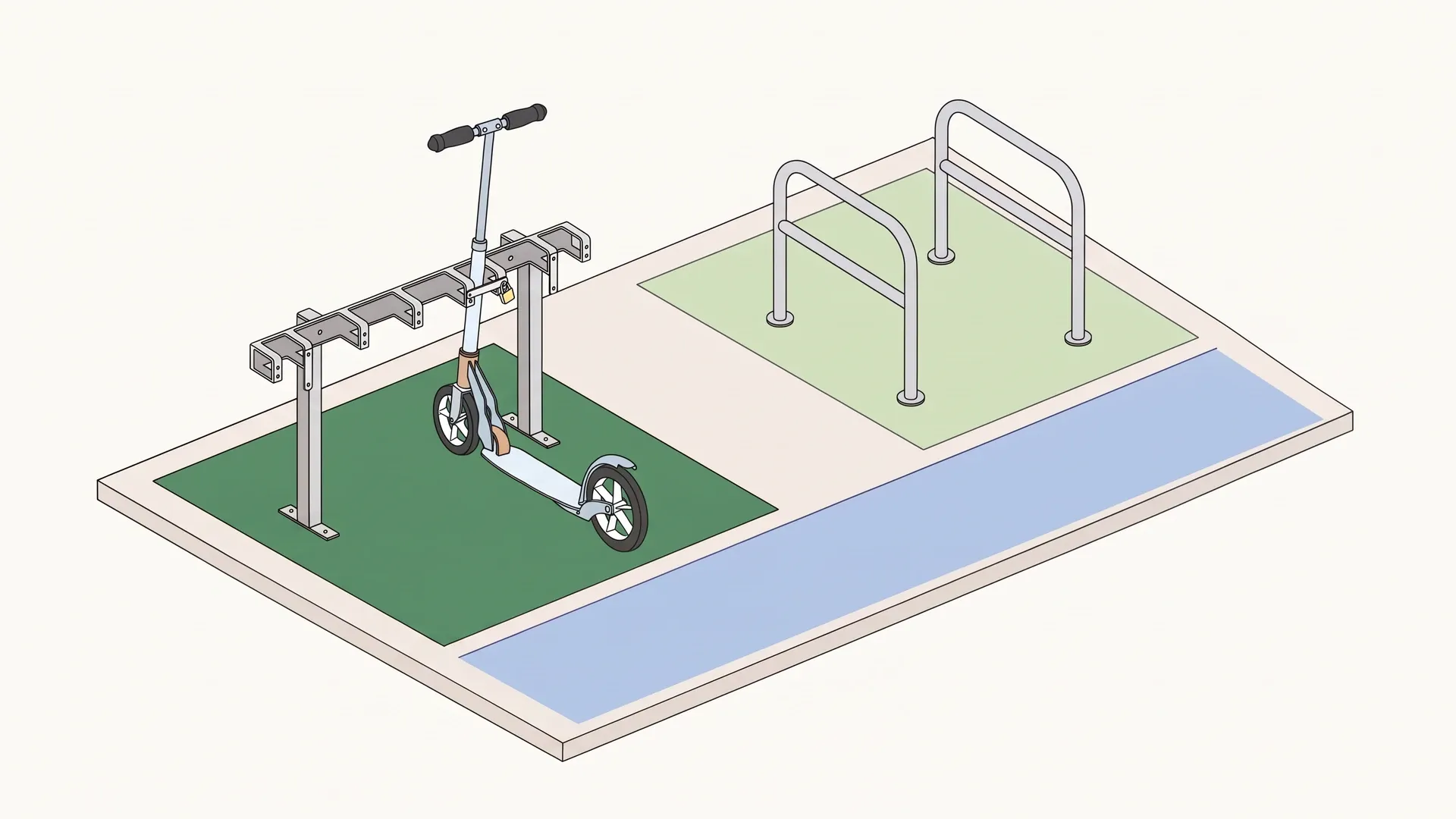
Planning mixed parking areas for scooters and bicycles
Plan mixed parking for schools and municipalities: separate vehicle bays, check shared access and choose suitable scooter and bicycle systems for the site.
7 min read
 Order & security
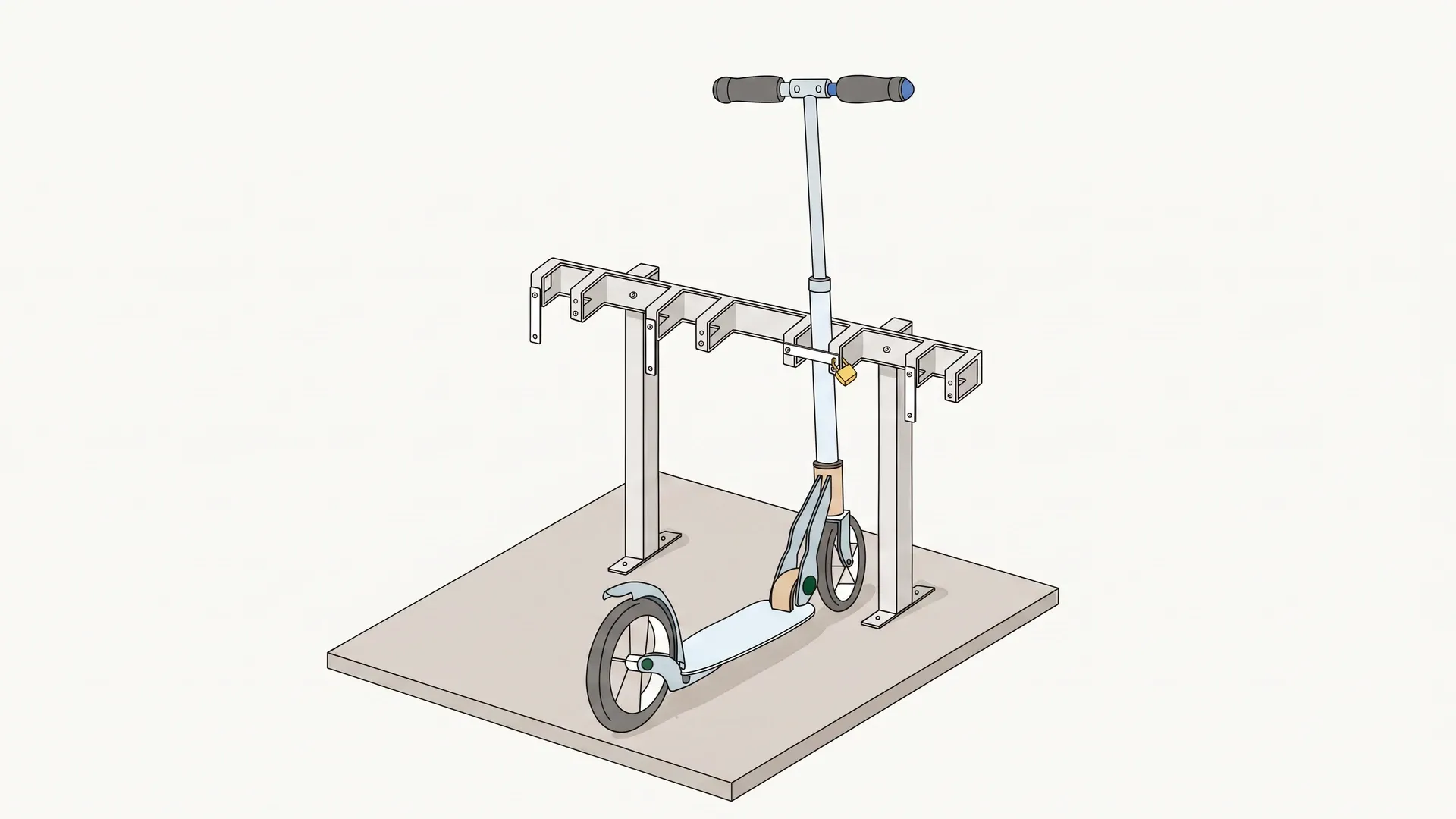
Locking kick scooters: What site operators should provide
Plan kick scooter locking for schools and shared sites: check stem fit, closure access, padlock operation and anchoring, with clear operating duties.
7 min read